
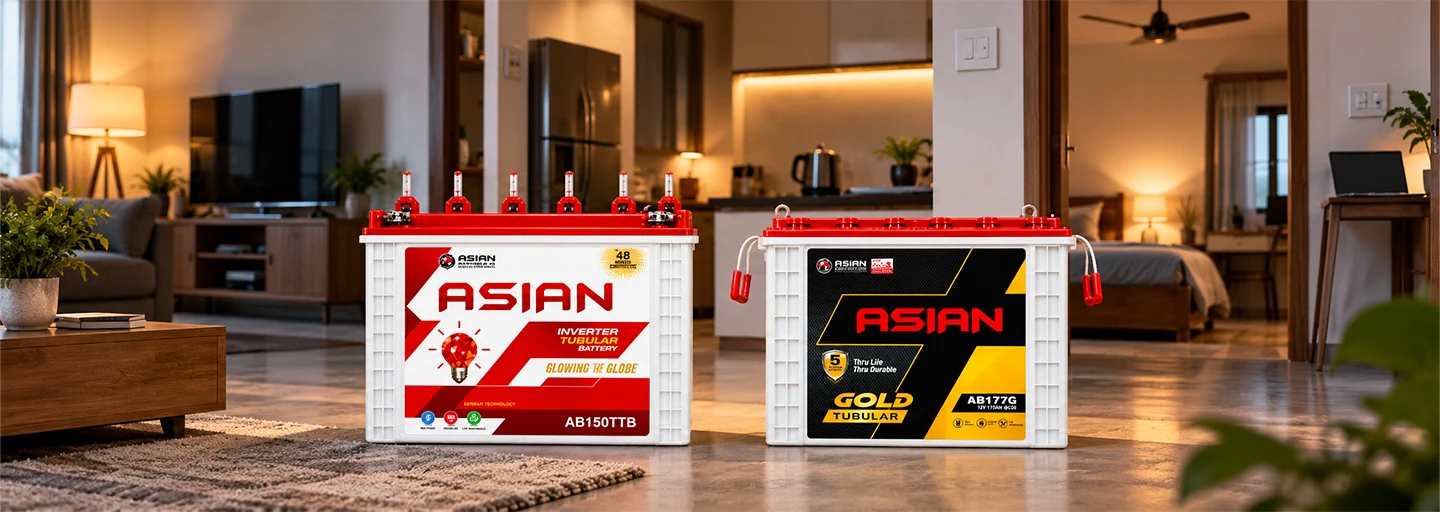
Best Backup Battery Capacity for Your Nepali Home: A Room-by-Room Load Calculation Guide
- Battery Care |
- Asian Batteries |
- 29 September, 2026 |
- 3 views |
- 0 comments
Power cuts aren’t as frequent as they once were in Nepal. But unexpected power cuts can happen, sometimes for longer durations, which can heavily interrupt work, study, and everyday routines. Knowing the capacity of an inverter battery you need to keep essential appliances running is quite important. Choosing the right capacity is quite economical, as […]
Table of Content
- Step 1: List the Appliances You Use During Power Cuts
- Where Can You Find the Wattage of Your Appliances?
- Step 2: Calculate Your Total Load
- Step 3: Consider How Long You Need Backup
- Step 4: Convert the Load into Battery Capacity
- Recommended Battery Capacity for Different Usage Patterns
- What About a 2BHK, 3BHK or 4BHK Home?
- Get the Right Backup for Your Home
Power cuts aren’t as frequent as they once were in Nepal. But unexpected power cuts can happen, sometimes for longer durations, which can heavily interrupt work, study, and everyday routines. Knowing the capacity of an inverter battery you need to keep essential appliances running is quite important. Choosing the right capacity is quite economical, as you don’t have to unnecessarily pay for a battery that is larger than you need.
The right battery depends on which appliances you use during a power cut, how much electricity they consume, and how long you need backup. This guide will help you with a simple way to calculate the battery capacity suitable for your home.
Step 1: List the Appliances You Use During Power Cuts
Start by making a list of the appliances you normally use when the electricity goes out. List the appliances you actually want to run through the inverter. For example, your list may include LED bulbs, ceiling fans, a television, a Wi-Fi router, laptop chargers, phone chargers, and other essential devices. You can make the list room by room.
Where Can You Find the Wattage of Your Appliances?
The wattage is usually written on a label, sticker, or specification plate attached to the appliance. List labels given in watts (W), voltage(V), and current(A).
For example, check:
- Fans: Look for a sticker or specification label on its motor or fan.
- TV: Check the label at the back of the television or its user manual.
- Laptop charger: Check the information printed on the charger.
- LED bulbs: Check the wattage printed on the bulb or its packaging.
- Wi-Fi router and ONU: Check the adapter connected to the device.
- Other appliances: Check the rating plate, product label, adapter, or manufacturer’s specifications.
If an appliance shows its power in Watts (W), use that number directly. If it only provides voltage (volts) and current (amperes), multiply the two to find watts:
Watts = Volts × Ampere
An LED bulb uses an estimated range of 5-15 watts, a phone charger 5-20 watts, a ceiling fan 50-90 watts, a table fan 25-75 watts, a laptop charger 45-100 watts, a refrigerator 100-300 watts, and an air conditioner 1,000-2,000 watts.
Step 2: Calculate Your Total Load
Once you have the wattage, multiply it by the number of appliances you plan to use at the same time.
For example,
| Appliance | Quantity | Average Watts | Total Watts |
|---|---|---|---|
| LED Bulb | 6 | 10W | 60W |
| Fan | 3 | 70W | 210W |
Suppose you get an essential running load of approximately 455 watts for your home.
Step 3: Consider How Long You Need Backup
Next, decide how many hours you want your battery to operate these appliances.
For example, if your total load is 455W and you want three hours of backup:
455W × 3 hours = 1,365Wh
This means your appliances require approximately 1,365 watt-hours during those three hours.
Step 4: Convert the Load into Battery Capacity
An inverter does not convert stored battery energy into usable power with 100% efficiency. You can use an 80% efficiency factor for the calculation, written as 0.8.
The standard formula is:
Battery Capacity (Ah) = [Total Load (W) × Backup Hours] ÷ [Battery Voltage (V) × Inverter Efficiency]
For a 455W load running for three hours with a 12V battery:
455 × 3 ÷ (12 × 0.8) = 142.18Ah
Since batteries are generally available in fixed capacity ratings, round up rather than choose a battery below the calculated requirement.
Recommended Battery Capacity for Different Usage Patterns
For a household requiring around 300W-450W of essential backup for two to three hours, use a 150Ah tubular battery, paired with an 850VA to 1100VA pure sine wave inverter.
If your backup requirement is much lighter, such as only a Wi-Fi router, two or three lights, and a laptop with a combined load of around 100W, a 100Ah battery may provide more than six to seven hours of continuous performance.
For heavier requirements above 800W, particularly where deep-pumping water systems or multiple rooms are involved, the guide recommends moving beyond a standard 12V setup to a 24V system with two 150Ah or 200Ah batteries connected in series.
What About a 2BHK, 3BHK or 4BHK Home?
The number of rooms alone does not determine the battery capacity you need. A 2BHK home with several fans and appliances running simultaneously can have a higher load than a 4BHK home using only essential lights and a router during an outage.
Instead of choosing a battery simply according to your home’s size, calculate the appliances you expect to use during a power cut. Add their wattages, estimate the required backup hours, and then convert the result into Ah. This approach helps you choose a battery based on your actual household load rather than the number of rooms.
Get the Right Backup for Your Home
Choosing the right inverter battery starts with knowing your actual power requirement. Check the wattage printed on your appliances, calculate your total running load, decide how many hours of backup you need, and account for inverter efficiency.
If you are unsure about your household’s load or which battery capacity is suitable, get a free load assessment from Asian Batteries. A professional assessment can help you understand your actual backup requirement and select a suitable battery and inverter combination without unnecessary overspending.
More Related Blogs

24 September, 2026
2nd Annual General Meeting (AGM) Notice



Comments 0
Write a Comment