
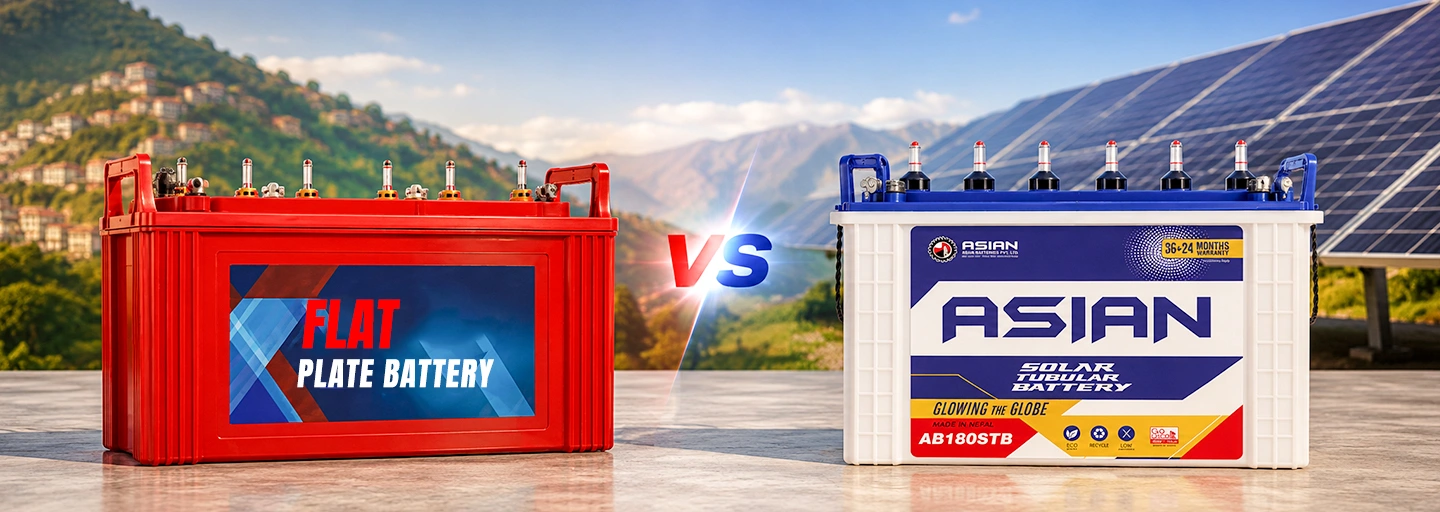
Tubular vs. Flat-Plate Batteries For Solar: Which Should You Choose In Nepal?
- Battery Technology |
- Asian Batteries |
- 23 July, 2026 |
- 51 views |
- 0 comments
When purchasing a battery for solar, choosing the right type can be confusing. In the market, several types of batteries are available such as Tubular and Flat-Plate batteries which are used by users for solar applications. While these batteries are commonly used, the advantages and usability these batteries provide are different, as they are designed […]
Table of Content
- How Tubular Batteries Work and Why They’re Popular For Solar In Nepal
- How Flat-plate Batteries Work And Their Typical Applications
- Tubular vs. Flat-Plate Batteries: Side-by-Side Comparison
- Which Performs Better During Nepal’s Long, Cloudy Monsoon Season
- Ideal Use Case For Each: Urban Solar Homes vs. Rural Off-Grid Systems
- Total cost of ownership breakdown over 5 years
- Conclusion
When purchasing a battery for solar, choosing the right type can be confusing. In the market, several types of batteries are available such as Tubular and Flat-Plate batteries which are used by users for solar applications. While these batteries are commonly used, the advantages and usability these batteries provide are different, as they are designed for distinct usage patterns.
But which batteries are best for solar applications in Nepal? In this blog we give information about the best battery for solar applications among Tubular and Flat-Plate batteries in Nepal for durability, reliability, backup, maintenance requirements, and long-term cost. The side-by-side comparison and performance of these batteries during monsoon are provided to help you choose the ideal battery.
How Tubular Batteries Work and Why They’re Popular For Solar In Nepal
Tubular batteries are designed for use in Solar systems or applications. The tubular batteries hold active materials inside the tubes, which helps to prevent shedding during deep discharges. This results in a longer and durable lifespan for more than 5 to 8 years, providing better efficiency and reliability.
In solar applications, the battery faces stress as it needs to charge constantly during the day and provide power during the evening or when electricity is unavailable. In such a scenario, using an ordinary battery can be inefficient, as the battery cannot handle continuous stress and loses its durability and performance. This is the reason that tubular batteries are popular in Nepal, as they give durability, longevity, and reliability in comparison to standard batteries.
How Flat-plate Batteries Work And Their Typical Applications
The Flat-Plate batteries use flat positive and negative plates in the lead grid to store electrical energy. These are common types of lead-acid batteries that are commonly used for power backup. As the materials are placed directly into the lead grid in Flat-Plate batteries, they shed easily during the deep discharge.
Flat-plate batteries are economical and attractive to consumers, as they require a lower upfront investment. But for solar applications, the total lifespan and performance can be affected due to deep discharge and repeated daily cycles. This is the reason that flat-plate batteries are not suitable for solar systems that require heavy battery storage every day. In comparison to tubular batteries, Flat-Plate batteries require frequent maintenance, and performance depends on appropriate usage.
Tubular vs. Flat-Plate Batteries: Side-by-Side Comparison
The differences in lifespan, depth of discharge, maintenance, initial price, long-term value, and solar application suitability of Tubular and Flat-Plate batteries are provided below:
| Feature | Tubular Battery | Flat-Plate Battery |
| Lifespan | Durable lifespan of more than 5 to 8 year | Shorter lifetime with average of 2 to 5 years |
| Depth of Discharge | Ideal for regular and deeper discharge cycle | Best for moderate and occasional discharge |
| Maintenance | Requires a less frequent maintenance interval with distilled water top-up requirement of every 2 to 6 months | Requires frequent electrolyte and water checks in comparison to tubular batteries. |
| Initial Price | Higher upfront price in comparison to flat-plate battery | Low upfront cost |
| Solar Suitability | Suitable for solar application due to its ability to prevent shedding during deep discharges | Less recommended is the battery stress in handling stress due to frequent daily charging and discharge cycles. |
| Long-Term Value | Gives best value with long-term durability and reliability | Economical but not ideal for reliability and long-term durability. |
Which Performs Better During Nepal’s Long, Cloudy Monsoon Season
Nepal’s monsoon season poses several challenges for solar power backup systems and batteries. Due to frequent rain and clouds, the solar panels lose their ability to charge the battery adequately in comparison to normal days. Also, the humid temperature in monsoon accelerates internal breakdown, causes terminal corrosion, and increases the risk of short circuits. Together with improper charge cycles, push significant stress on the battery.
To deal with such monsoon conditions in Nepal, the solar application requires using a battery that can handle stress.
Tubular batteries are suitable and ideal in this case in comparison to flat-plate batteries, as they are able to handle stress during deep discharge and charging cycles. Their thick-plate design is built to handle frequent and prolonged power outages and heavy deep discharges during severe storms. Also, its sealed and protective tubular design resists high humidity and fluctuation in temperature that leads to corrosion.
Ideal Use Case For Each: Urban Solar Homes vs. Rural Off-Grid Systems
Tubular batteries are ideal for use in urban solar applications that require reliable backup and undisrupted performance. They are the best choice for homes that require higher energy consumption, have larger inverter systems, and have frequent daily battery cycling. For Rural off-grid systems where electricity is limited, the tubular batteries again can be ideal for use. As off-grid systems depend on stored solar energy for everyday energy, tubular batteries handle frequent battery stress and provide the best backup and reliability.
Meanwhile, Flat-plate batteries can be used for smaller solar and inverter systems to handle the energy needs of small homes, offices, and shops to meet occasional backup.
Total cost of ownership breakdown over 5 years
The total cost of ownership between a flat-plate battery and a tubular battery for solar applications or any other use case in Nepal is provided below:
| Cost Category | Flat-Plate Battery | Tubular Battery |
| Initial Purchase Price | NPR 14,000 to NPR 20,000, depending upon size and capacity | NPR 22,000 to NPR 28,000 or more depending upon size and capacity |
| Average Lifespan in Nepal | 2 to 5 years of average lifespan according to use condition | 5 to 8 years or more lifespan depending upon use condition. |
| Replacements (5 Years) | May require 1 replacement | Replacement might not be required |
| Distilled Water Maintenance | NPR 3,000 for interval for 1 to 3 months | NPR 1,200 for interval for 3 to 4 months |
| Estimated 5-Year Total cost of ownership | NPR 28,500 to NPR 35,500 in average | NPR 19,200 to NPR 23,700 in average |
Conclusion
Tubular and flat-plate batteries are widely used in Nepal, whether that is for solar applications or for inverters. But for solar applications, tubular batteries are the best choice due to their deep discharge capabilities, longer backup, and reliable performance during the humid monsoon weather of Nepal. They are ideal for use in urban homes, businesses, or offices and rural off-grid systems that require frequent solar energy backup. Meanwhile, Flat batteries are practical for use in smaller inverter or solar systems for occasional backup and one requiring initial investment.
Looking for a reliable solar tubular battery for long-term durability, reliability, and performance for your home, business, or off-grid system in Nepal? Visit Asian Batteries and explore wide ranges of solar batteries engineered for efficient solar energy storage, low self-discharge, long-lasting deep cycle design, and environmentally friendly design.
More Related Blogs
13 October, 2026
How to Refill Water in Inverter Batteries?
08 October, 2026
Is Tubular Battery Fit for Solar Applications?

24 September, 2026
2nd Annual General Meeting (AGM) Notice



Comments 0
Write a Comment