
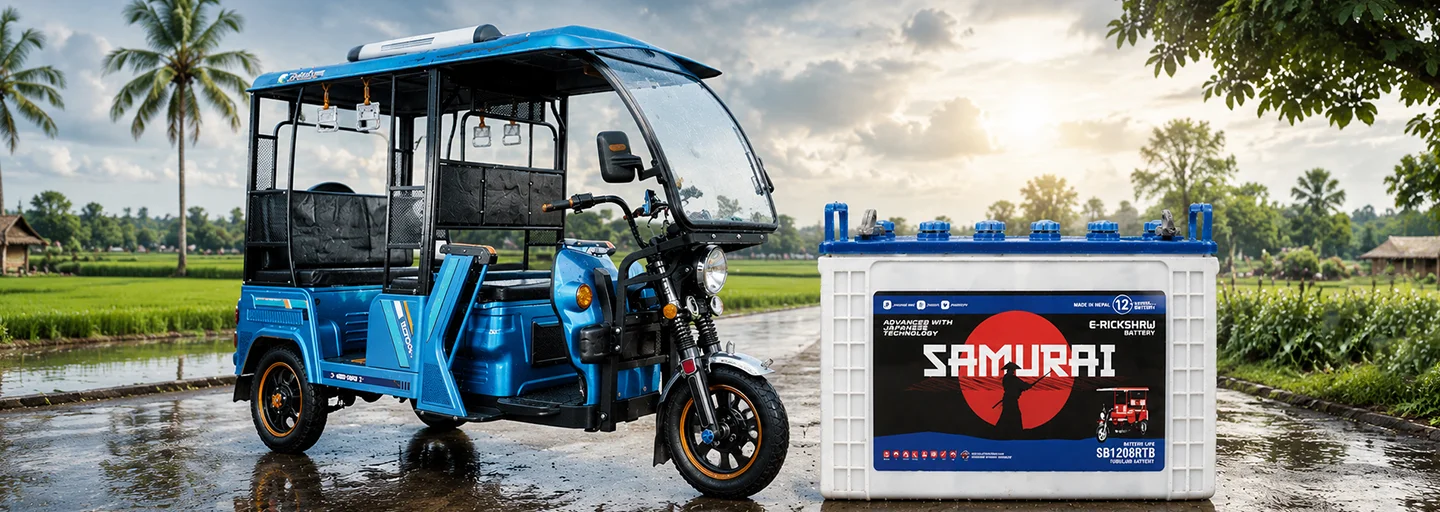
E-Rickshaw Battery Maintenance Guide: Extend Your Tubular Battery Life in Nepal
- Battery Care |
- Asian Batteries |
- 29 May, 2026 |
- 86 views |
- 0 comments
E-rickshaws are popular means of transportation in semi-urban and urban areas of Nepal due to accessibility, affordability, and eco-friendliness. Their maneuverability, performance, and ability to navigate narrow roads further increased its need in countries like Nepal. However, in terms of maintenance, one of the major factors leading to increasing expenditure is its battery replacement. The […]
Table of Content
- Understanding Tubular Battery Discharge Cycles For E-Rickshaws
- Daily charging routine: Best practices for Nepali operators
- How To Avoid Deep Discharge
- Water Topping And Terminal Cleaning Schedule
- Signs Your E-rickshaw Battery Needs Replacement
- How Proper Maintenance can add 1-2 years to battery life
- Conclusion
E-rickshaws are popular means of transportation in semi-urban and urban areas of Nepal due to accessibility, affordability, and eco-friendliness. Their maneuverability, performance, and ability to navigate narrow roads further increased its need in countries like Nepal.
However, in terms of maintenance, one of the major factors leading to increasing expenditure is its battery replacement. The main reasons for quick battery damage in E-rickshaws are frequent overloading, deep discharging, unstable charging voltage, exposure to extreme temperatures, and poor road conditions in Nepal. But, with proper care, maintenance, and following battery maintenance habits, you can increase the tubular battery life of your E-rickshaws in Nepalese road conditions.
In this blog, we provide detailed information about the Tubular battery used in E-rickshaws, including its battery discharge cycles. The daily charging routine, ways to avoid deep discharge, and water-topping or terminal cleaning schedule are also provided. Also, the signs you must check for replacing the e-rickshaw battery and ways to maintain or extend its lifespan are also provided.
Understanding Tubular Battery Discharge Cycles For E-Rickshaws
Tubular batteries in e-rickshaws are deep-cycle batteries meant to deal with repeated charging and discharging. Although the tubular batteries are charged fully and discharged quickly due to operation, they last for a longer time period.
A discharge cycle means the complete process in which your E-rickshaw battery charges to its full capacity and discharges upon use. The more charging cycles you reach and let the battery discharge, the more it puts stress on the battery. This means deep discharging or using E-rickshaw in low battery contributes to degradation of battery health. As a result, you get less backup and the battery damages quickly.
Daily charging routine: Best practices for Nepali operators
If you own an E-rickshaw or use it daily as a source of income, following the appropriate daily charging habit is important to save your maintenance expenses on the battery. Some of the best practices the Nepali E-rickshaw operators can use to maintain their e-rickshaw battery health are:
- Charging the battery in limit without overcharging or undercharging
- Using recommended and compatible battery charger for optimal battery health
- Avoiding charging during unstable electricity or during electricity fluctuation
- Managing proper ventilation if you are charging inside closed space
- Avoiding operation until the low limit of battery.
How To Avoid Deep Discharge
Along with proper charging habits, operators must also take care to avoid deep battery discharge issues. This includes operating the vehicle within the specified battery limit, regular monitoring of battery power, operating the e-rickshaw within the specified load limits, and disconnecting the battery terminal when not used for a long term. Some of the best practices you can use to avoid deep discharge of your tubular E-rickshaw battery include the following:
- Monitoring battery voltage regularly by charging when battery power drops below 10.5V per 12V battery.
- Allow the battery charger to complete its full charge cycle by avoiding charging disruption or an incomplete charging process
- Use specified charger recommended by operators
- Maintain the battery state of charge (SoC) to get below 20% to 30%.
- Avoid hard acceleration and exceeding recommended weight limits, as they increase battery drain faster while straining the battery.
Water Topping And Terminal Cleaning Schedule
Regular water topping and terminal cleaning are important to maintain battery health and backup for your E-rickshaw. Using distilled water as regular water for topping and cleaning with proper procedure helps in maximizing its lifespan. The proper schedule for water topping and terminal cleaning is provided below:
| Maintenance Task | Recommended Schedule |
| Water Level Inspection | Every 15 days to 30 days |
| Distilled Water Topping | Depending upon inspection and water level |
| Terminal Cleaning | Every 2 to 3 months |
| Terminal Tightness Check | Monthly |
| Battery Surface Cleaning | Every 15 days |
| Complete Battery Inspection | Every 2 to 3 months |
Signs Your E-rickshaw Battery Needs Replacement
Upon daily use and increasing charge cycles, your E-rickshaw battery requires replacement at specific times. You get various signs and symptoms once your battery needs replacement. Some of the signs and symptoms that show the replacement need of your battery are provided below:
- Takes extra time to charge than usual conditions
- Low battery backup
- Sluggish performance
- Overheating and deformation of battery shape
- Corrosion in battery terminals
- Overheating during normal charge
- Difficult to power vehicle’s core electronics like radio, lights, horns, and displays
How Proper Maintenance can add 1-2 years to battery life
While the condition of Nepal’s climate, road conditions, and irregular driving habits of Nepalese drivers decrease battery health more than usual, proper maintenance and care can help in increasing its lifespan for more than 1-2 years. The increased lifespan saves you instant expense and support economically by providing longevity. Proper maintenance adds extra lifespan to your E-rickshaw battery by:
- Avoiding damage from deep discharge and overcharge
- Maintaining battery health through regular charge cycle
- Protecting internal component or plates with regular water changes
- Efficient energy transfer due to clean battery terminal
- Minimizing the chance of corrosion due to regular cleaning and maintenance.
Conclusion
The geographical condition, climate, road condition, and driving habits of Nepalese drivers influence the lifespan and performance of E-rickshaw batteries. The battery health decreases faster when used extensively under a deep discharge cycle. Meanwhile, charging within the limit, regular inspection and maintenance, appropriate load bearing, and regular cleaning increase the lifespan and performance.
For reliable performance, long-term durability, and efficiency, purchasing batteries from trusted suppliers and manufacturers like Asian Batteries can also be beneficial. Contact Asian Batteries for various types and ranges of batteries for unmatched performance and durability for your E-rickshaw in Nepal.
More Related Blogs
13 October, 2026
How to Refill Water in Inverter Batteries?
08 October, 2026
Is Tubular Battery Fit for Solar Applications?

24 September, 2026
2nd Annual General Meeting (AGM) Notice



Comments 0
Write a Comment