
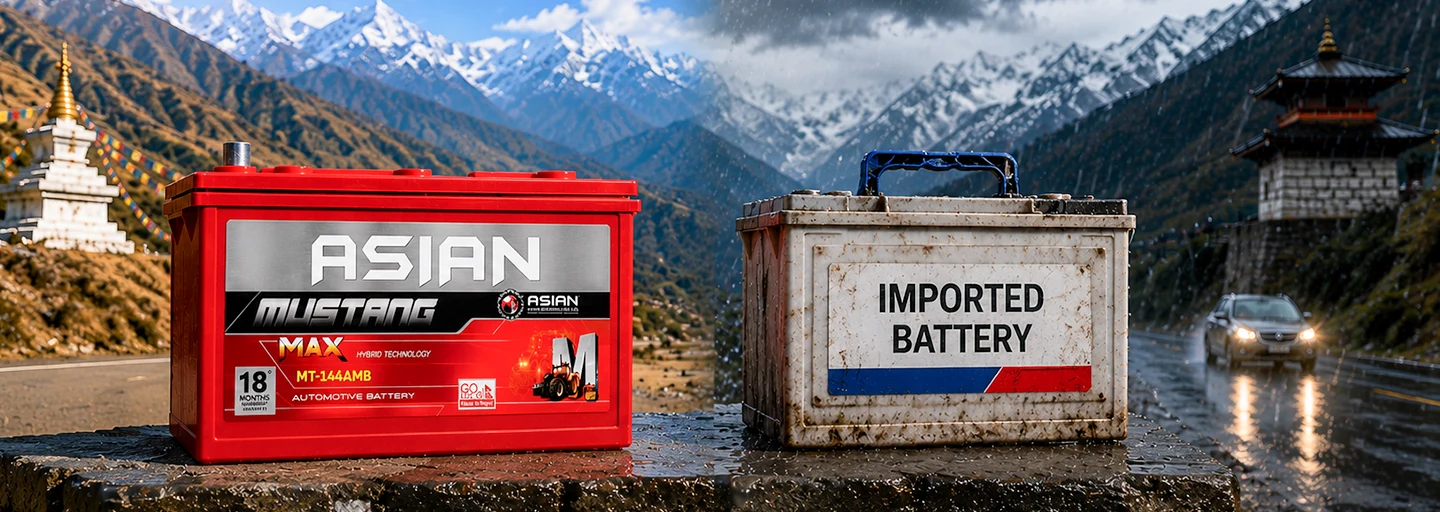
Why Locally Manufactured Batteries Outperform Imported Ones in Nepal’s Climate
- Battery Technology |
- Asian Batteries |
- 18 May, 2026 |
- 77 views |
- 0 comments
Nepal’s battery market has one argument that never goes away. Should you buy a locally manufactured battery or trust an imported brand? Walk into any hardware shop in Kathmandu, Pokhara, or Birgunj and you will see shelves stacked with both options. Imported batteries often look good on the outside and carry price tags that suggest […]
Table of Content
- Nepal’s Climate Demands a Specialised Battery
- How Asian Batteries Engineers Products for Nepal’s Specific Conditions
- Quality Certifications: What ISO and CE Actually Guarantee
- Price Comparison: Total Cost of Ownership, Local vs. Imported
- After-Sales Service Advantage of Buying Local
- Environmental Impact: Fewer Shipping Miles, Local Recycling Support
- Conclusion
Nepal’s battery market has one argument that never goes away. Should you buy a locally manufactured battery or trust an imported brand? Walk into any hardware shop in Kathmandu, Pokhara, or Birgunj and you will see shelves stacked with both options. Imported batteries often look good on the outside and carry price tags that suggest high quality. But looks and labels do not mean performance in Nepal’s conditions. The real question is not where the battery comes from. The real question is whether it was built for where you actually live.
Nepal’s Climate Demands a Specialised Battery
Nepal is not a single climate. It is three completely different worlds stacked vertically on top of each other. The Terai plains of Birgunj and Hetauda sit below 300 metres and see temperatures above 40 degrees Celsius in summer with monsoon humidity exceeding 80 percent. The mid-hills of Kathmandu and Pokhara run from around 800 to 1500 metres and see cold winters that regularly drop below 5 degrees. The high mountain zones above 3000 metres experience freezing temperatures, thin air, and dramatic pressure changes year-round.
Each of these zones punishes a battery in a different way. High humidity corrodes terminals and weakens electrolyte concentration. Extreme heat accelerates the chemical breakdown inside battery cells. Cold temperatures reduce the battery’s ability to deliver power on demand. A battery designed for flat, moderate climates in China or India does not account for these three zones working against it at once. You are not imagining the early failures. The climate is doing exactly what it was never designed to handle.Here is how Nepal’s climate zones affect battery performance:
- Terai (Birgunj, Butwal, Hetauda) – High heat and humidity corrode terminals faster and reduce electrolyte life
- Mid-hills (Kathmandu, Pokhara, Dharan) – Seasonal swings between hot summers and cold winters stress battery plates repeatedly
- High hills and mountains – Thin air reduces cooling, cold temperatures cut cranking power, and altitude affects electrolyte pressure
How Asian Batteries Engineers Products for Nepal’s Specific Conditions
Asian Batteries does not ship a generic product and hope it survives. The battery design process starts with Nepal’s conditions and works backwards. The company manufactures in Nepal, which means the engineering team experiences the same climate as the customer. That direct exposure matters in a way that a factory in another country simply cannot replicate.
Locally manufactured batteries for Nepal go through plate thickness adjustments that account for rapid charge-discharge cycles caused by load-shedding patterns. The battery electrolyte formulation is calibrated for the temperature range between Terai summers and mountain winters. Terminal alloys are selected for corrosion resistance in high-humidity monsoon conditions. When you buy from Asian Batteries, you are buying a product that was built with Kathmandu’s dust, Pokhara’s rain, and Birgunj’s heat already factored in.
Quality Certifications: What ISO and CE Actually Guarantee
Certifications matter. But you need to know what they are actually certifying. ISO 9001 certification confirms that a manufacturer follows a documented and consistent quality management process. It means every battery leaving the facility meets the same production standard, not just the ones you test. CE marking confirms that the product meets European safety and performance requirements, which are among the strictest in the world.
Asian Batteries carries both. For you as a Nepali consumer, that means two things. First, you are not buying from an unchecked production line. Second, you have a quality benchmark that holds the manufacturer accountable on paper and in practice. Many imported batteries in Nepal’s market carry no verifiable certification at all. A battery without ISO or CE documentation is essentially asking you to trust the label with no evidence behind it.
Price Comparison: Total Cost of Ownership, Local vs. Imported
The upfront price of an imported battery can look lower. That comparison stops being accurate the moment you account for the full cost of ownership. Consider what happens when an imported battery fails in 14 months instead of the expected 36. You pay for a replacement battery. You pay for a technician’s time. If the failure caused damage to your inverter or alternator, repair costs in Kathmandu and Biratnagar can run between Rs. 8,000 and Rs. 25,000 depending on your equipment. A locally manufactured battery that performs reliably for its full rated life costs significantly less over three years than an imported battery that fails twice in the same period.
Nepal-made batteries also carry no import markup. No shipping freight, no customs duties, no distributor margins stacked across three countries. That saving stays with you from day one.
After-Sales Service Advantage of Buying Local
This is where locally manufactured batteries in Nepal separate themselves completely. When an imported battery fails, your service options narrow quickly. The importer may have already moved to a new supplier. The warranty paperwork may require sending a product overseas. Response time in those scenarios is measured in weeks, not days.
When you buy from Asian Batteries, the service network is local. Warranty claims are handled in Nepal. Technicians who understand the product are reachable in the same city where you bought it. If something goes wrong with your inverter battery or automotive battery, you are not waiting on an international response chain. You are talking to a team that has the same phone code as you.
Environmental Impact: Fewer Shipping Miles, Local Recycling Support
An imported battery travels thousands of kilometres before it reaches a shop in Pokhara or Kathmandu. That journey carries a carbon cost that does not show up on the price tag. Every battery imported from overseas adds shipping emissions, packaging waste, and logistics chain pollution to its lifecycle before it is even installed.
Locally manufactured batteries eliminate most of that footprint. Production, distribution, and end-of-life recycling all happen within Nepal. Asian Batteries supports proper battery disposal and recycling within the country, which keeps lead acid battery waste out of riverbeds and open landfills. Choosing local is not only practical. It is the responsible choice for Nepal’s environment.
Conclusion
Nepal’s climate, road conditions, and power infrastructure are not average. They demand a battery that was built with those realities in mind. Imported batteries are not engineered for monsoon humidity in Hetauda, cold cranking demand in Solukhumbu, or the load-shedding cycles that Kathmandu households still navigate. Asian Batteries is.
Explore the full range of locally manufactured automotive, inverter, and motorcycle batteries at Asian Batteries and find the right battery for your vehicle, your home, and your climate.
More Related Blogs


Comments 0
Write a Comment